Cauda equina syndrome is one of the few conditions in medicine where a few hours can separate a full recovery from permanent bladder, bowel and sexual dysfunction. Claims arising from it rarely argue about whether the condition is serious. They argue about a timeline.
In short: cauda equina syndrome is compression of the nerve roots below the end of the spinal cord, and it is treated as a surgical emergency because the damage becomes fixed. A negligence claim almost always alleges delay rather than a technically poor operation, so breach of duty turns on whether a clinician asked about and acted on the red flags in front of them, and whether the scan happened when the national pathway says it should. Causation is the harder half, because the claimant has to show that earlier surgery would have left them better off, not simply that the delay was wrong.
Prof. Sandip Hindocha, a Consultant Plastic Surgeon and the UK’s National Lead Forensic Medical Examiner, prepares medical negligence expert reports in which the decisive question is usually the one that decides these cases too, which is what a reasonable clinician should have done with the information recorded in front of them at the time.
What Cauda Equina Syndrome Is
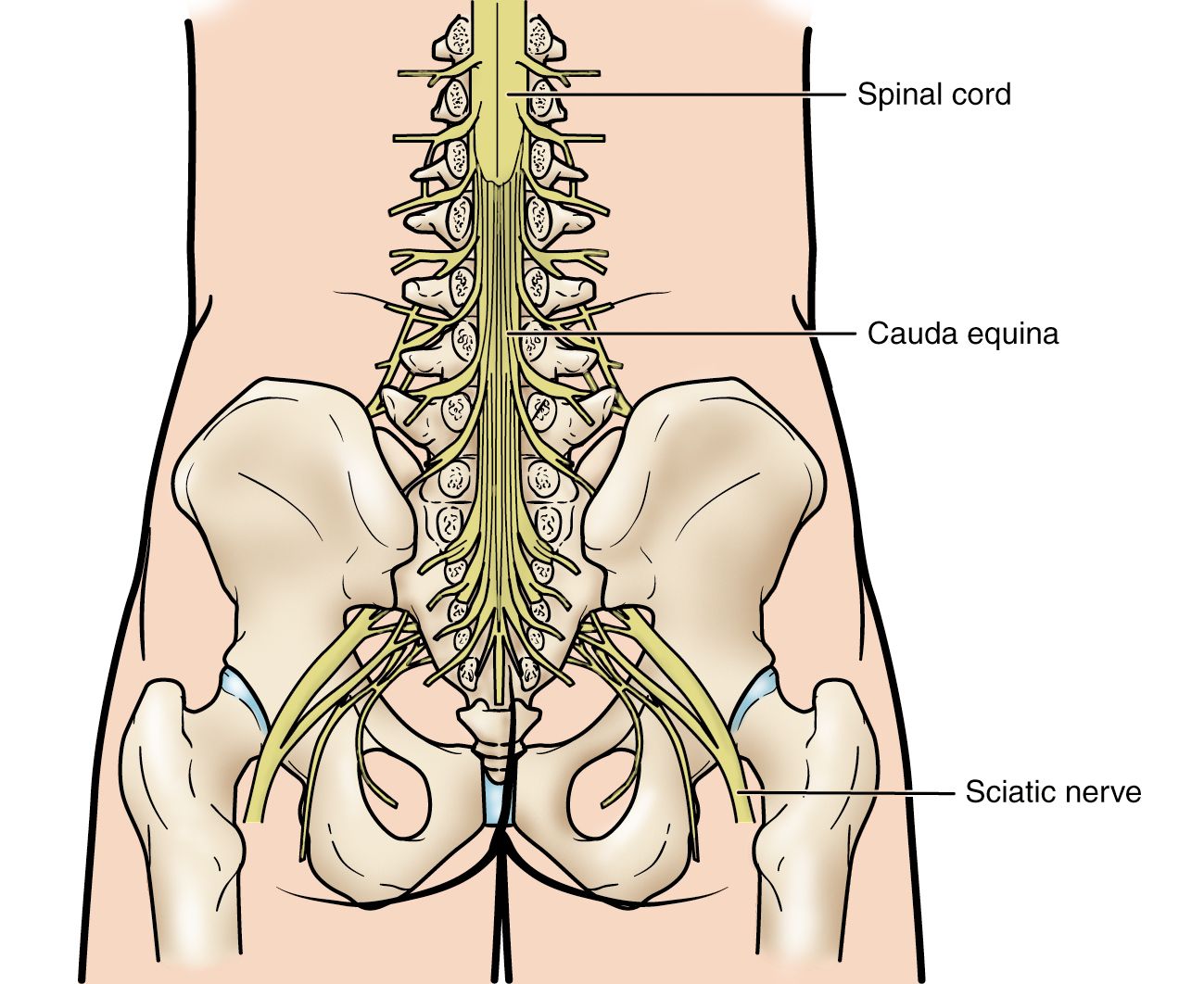
The spinal cord ends at about the first or second lumbar vertebra. Below that point the spinal canal carries a bundle of nerve roots, the cauda equina, which supply the legs, the bladder, the bowel and the perineum. Compression of that bundle produces the syndrome. The most common cause is a large lumbar disc herniation, but tumour, haematoma, infection and severe spinal stenosis all do it.
Because those roots carry motor, sensory and autonomic fibres together, the presentation mixes leg symptoms with bladder, bowel and genital symptoms. That mixture is what separates the condition from ordinary sciatica, and it is the part a clinician is expected to ask about rather than wait to observe.
Why the Timeline Decides the Case
Compressed nerve roots can recover once the pressure is taken off them. Autonomic function is the least forgiving. Once bladder control has been lost for long enough, decompression often does not bring it back, and the claimant is left with lifelong catheterisation, faecal incontinence or loss of sexual function.
That means the clinical urgency and the legal question are the same question asked twice. Every interval in the timeline is either explained by the records or it is not, and a report that does not set out those intervals hour by hour has not done the work.
The Red Flags a Clinician Is Expected to Ask About

NICE’s clinical summary for cauda equina syndrome sets out the features that should prompt emergency assessment in someone with back or leg pain.
- Bilateral sciatica.
- Severe or progressive bilateral neurological deficit of the legs, such as major motor weakness with knee extension, ankle eversion or foot dorsiflexion.
- Difficulty initiating micturition, or impaired sensation of urinary flow.
- Loss of sensation of rectal fullness.
- Perianal, perineal or genital sensory loss, described as saddle anaesthesia or paraesthesia.
- Laxity of the anal sphincter.
Most of that list cannot be observed. It has to be asked about, and in terms a patient in pain will understand. A note reading “no red flags” without any record of what was asked is weaker evidence than it appears, and both sides will read it that way. Where a claimant says they reported altered sensation when wiping, or that they could not tell when their bladder was full, and the record is silent, the case turns on which account the court accepts rather than on any point of medicine.
What the National Suspected Cauda Equina Pathway Requires
In February 2023 the NHS Getting It Right First Time programme published a National Suspected Cauda Equina Syndrome Pathway, co-badged by eleven organisations including the British Association of Spine Surgeons, the Society of British Neurological Surgeons, the Royal College of Radiologists and the Chartered Society of Physiotherapy.
Its central requirement is urgent referral by a senior decision maker to a twenty four hour MRI service, with the scan performed locally at the hospital where the patient presented rather than after transfer to a spinal centre. The reasoning is that transfer is where the hours go.
For any presentation after it was published, that document is what both parties will be measured against. It does not set the legal standard by itself, but it is a published and widely endorsed statement of what reasonable practice looked like, so a departure from it needs an explanation and a compliance with it is worth pleading.
Bladder scanning sits alongside the clinical assessment rather than replacing it. No safe cut off residual volume is accepted, so a reassuring post void volume does not exclude the diagnosis, and an opinion that treats it as a rule out is arguing against the pathway it is being judged by.
How the Stages Are Classified
The staging most often used in reports comes from a classification published in International Orthopaedics in 2022 by Lavy, Marks, Dangas and Todd, which extended the older incomplete and retention split into five categories.
| Stage | What it describes |
|---|---|
| CESS, suspected | Symptoms or imaging that raise the possibility, without established cauda equina signs |
| CESE, early | Reduced perineal sensation with normal bladder function, or altered micturition with normal sensation |
| CESI, incomplete | Neurogenic urinary difficulty and altered urinary sensation, with voluntary bladder control preserved |
| CESR, with retention | Bladder no longer under voluntary control, with painless retention and overflow incontinence |
| CESC, complete | Loss of cauda equina sensory and motor function |
The stage at each recorded contact, and the stage at operation, is often the single most valuable set of facts in the file. The distance between them is what the causation argument is actually about.
Where Breach of Duty Usually Sits

The allegations recur. Red flags not asked about, or asked about and not recorded. Symptoms recorded by a triage nurse or a physiotherapist and not escalated. An MRI requested but not prioritised overnight. A scan performed and reported but the report not read for hours. Discharge with advice to return if things worsen, in a patient who had already described altered perineal sensation.
Each of those is judged by the Bolam test, which asks whether the clinician acted in accordance with a practice accepted as proper by a responsible body of medical opinion, as refined by Bolitho so that the opinion relied on has to be logically defensible. A published national pathway does not displace that test. It changes what a responsible body of opinion can plausibly be said to accept.
Why Causation Is the Harder Half
Breach is often the easier finding. The claimant then has to show, on the balance of probabilities, that the delay made a difference. In practice that means showing that decompression at the earlier point would have produced a materially better outcome than the one they have.
Where a patient arrived already in painless retention, or with complete loss of function, a delay can be plainly indefensible and still cause no additional injury. Defendants succeed on exactly that basis, and claims are lost on it after breach has been conceded. A report on causation in a complex medico-legal case has to engage with the counterfactual directly rather than treating a proven delay as sufficient. That is also how sepsis recognition failures are analysed, because the patient’s condition at the point the delay began decides whether the delay changed anything.
What the Records Have to Show
The useful version of the chronology is granular. First contact and what was said on it. Triage time and triage category. Who assessed the patient, what was asked, what was examined and what was found. When the MRI was requested, when it was performed, when it was reported and when the report was read. When the referral to the spinal service was made and accepted. When the patient reached theatre.
A gap in a record is not the same as the absence of a symptom, and it is not the presence of one either. A report has to state which way it is reading each gap, and why, because that is the reasoning the other side will test.
How the Resulting Injury Is Valued
Bladder function, bowel function and sexual function are valued in their own chapters of the Judicial College Guidelines, alongside any residual leg weakness, altered sensation and chronic pain. In a severe case the general damages are usually the smaller part of the claim. Care, equipment, home adaptation and loss of earnings carry the value.
Choosing a bracket is not the expert’s job. Describing residual function precisely is, along with what treatment remains available, what the likely long term picture is, and what the claimant can and cannot do unaided. A valuation can be built on that. It cannot be built on a conclusion that the injury is severe.
Instructing the Right Discipline
The clinical issues in these claims belong to a spinal surgeon or a neurosurgeon, with a urologist where bladder outcome is disputed and often an emergency medicine opinion on what should have happened at the front door. A medical expert witness from a discipline that does not cover the allegation can be given little weight however carefully the report is written, and the point is worth checking before the letter of instruction goes out rather than after exchange.
Frequently Asked Questions
How quickly does suspected cauda equina syndrome need to be scanned?
The national pathway asks for urgent referral by a senior decision maker to a twenty four hour MRI service, performed at the hospital of presentation rather than after transfer. Individual trust protocols set their own target intervals from request to scan, and the local protocol in force on the day is part of the disclosure in any claim.
Does a normal bladder scan rule it out?
No. There is no accepted safe cut off residual volume, and patients have gone to emergency surgery with reassuring post void volumes. A bladder scan supports the assessment. It does not replace asking about perineal sensation and urinary sensation.
Can a claim succeed if the patient was already in retention on arrival?
It is harder. If function was already lost before the negligent delay began, the delay may have changed nothing, and causation fails even where the breach is admitted. The answer depends on the staging recorded at each contact rather than on the length of the delay.
Does the pathway apply outside hospital?
It was co-badged by the Chartered Society of Physiotherapy as well as the surgical bodies, and community practitioners are among its intended audience. A physiotherapist or GP who recorded red flag symptoms and did not send the patient to an emergency department is being judged against the same published expectation.
How long is there to bring a claim?
The general rule under the Limitation Act 1980 is three years from the date of knowledge, with different rules for children and for people who lack capacity. Whether a particular claimant is in time is a question for their solicitor, not for a medical expert.
Related reading
- Expert Advisor vs Expert Witness, and Why the Difference Matters
- How to Write a High Quality Expert Witness Report
- Why Independent Clinical Opinion Matters in Medico-Legal Cases
Prof. Hindocha prepares CPR Part 35 compliant reports for solicitors and insurers across England and Wales in his own areas of practice, and takes the same approach to a disputed chronology wherever it arises. Details of his medical negligence expert witness services and how to instruct him are on the instruction page.
This article is general information about how delay in diagnosing cauda equina syndrome is assessed in clinical negligence claims in England and Wales. It is not medical advice, and it is not a substitute for legal advice on a specific claim. Anyone with new bladder, bowel or perineal symptoms alongside back or leg pain should be assessed as an emergency.